Newborn hearing screening: why every baby's hearing should be checked early
Hearing loss in babies is often invisible. Universal newborn hearing screening, the 1-2-3 rule, and why early detection in the first months protects speech, language, and brain development.
Many parents assume that if a newborn looks healthy and “seems to respond”, everything is fine. But hearing loss in babies is one of the most invisible conditions in medicine. A baby can look completely normal, feed well, and even react to bright lights and footsteps—while missing the speech sounds that the brain needs in the first critical months of life.
That is why newborn hearing screening is no longer optional. It is one of the simplest, cheapest, most effective tests in modern paediatric care—and it can change a child’s entire future.
This guide draws on a recent advisory from Dr Manoj M.P., immediate past president of the Cochlear Implant Group of India (CIGI), and explains why every baby’s hearing should be checked, what the tests actually involve, what the results mean (and don’t mean), and what parents in Trivandrum and across Kerala should do if there are any concerns.
The single most important fact: in hearing loss, time is brain. Every month of delay in detection costs language, speech, and learning that is much harder to make up later.
Why early hearing matters
The first year of life is when a baby’s brain rapidly builds the pathways for:
- Listening to speech sounds.
- Understanding language.
- Learning new words.
- Social bonding with parents and family.
- Cognitive development that supports later learning.
These pathways are built only when sound reaches the brain. If hearing loss is detected late—say, at 2 or 3 years old—the child has already missed thousands of hours of language input during the most plastic period of brain development.
Children with late-detected hearing loss often experience:
- Delayed speech and language.
- Smaller vocabulary for years afterwards.
- Learning difficulties in school.
- Social and behavioural challenges.
- Need for prolonged, more intensive therapy to catch up.
Children with early-detected and early-treated hearing loss, in contrast, can develop language at near-normal levels and integrate fully into mainstream schooling.
Hearing loss in babies is more common than people realise
Globally accepted figures are striking:
- 1 to 3 babies per 1,000 in the general newborn population have significant hearing loss.
- 10 to 20 babies per 1,000 in NICU populations are affected.
That makes congenital hearing loss more common than many conditions for which routine screening is unquestioned. NICU babies—those who needed intensive care after birth—are at particularly high risk and warrant especially careful screening.
A point that is often missed: nearly half of babies with hearing loss have no obvious risk factors. They look healthy, the pregnancy was uncomplicated, the family history is clear—and yet the baby cannot hear. This is precisely why screening every baby (universal newborn hearing screening), not just those with risk factors, is the global standard of care.
Every baby should have a newborn hearing test
Leading paediatric and ENT bodies worldwide—and the Cochlear Implant Group of India (CIGI)—recommend Universal Newborn Hearing Screening (UNHS): every baby, regardless of risk factors, should have hearing screened in the first weeks of life.
A recent advisory by Dr Manoj M.P., immediate past president of the Cochlear Implant Group of India (CIGI), has drawn renewed attention to a stubborn problem in Indian paediatric audiology: despite excellent rates of in-hospital delivery, many children with significant hearing loss are still being identified only after 2 years of age—by which time the child has already missed the most critical window for language development. The advisory makes a strong case for mandatory, universal newborn hearing screening before hospital discharge, irrespective of risk factors. As an ENT community, this is a position we strongly endorse.
Universal screening, performed before discharge, is the single most effective way to close that diagnostic gap.
The 1-2-3 rule: the global timeline
International guidelines distil best practice into a simple, memorable timeline that every parent can hold their care team to:
By 1 month — screening
The baby should have completed initial hearing screening, ideally before discharge from the maternity hospital.
By 2 months — diagnosis
If the screening did not pass, full diagnostic audiological testing should be completed to confirm whether hearing loss is present and characterise its type and severity.
By 3 months — intervention
If hearing loss is confirmed, early intervention should already be starting—hearing aids fitted, parent counselling done, and a plan for speech-language therapy in place.
This is known as the 1-2-3 rule (or in some literature, 1-3-6, depending on the source). The principle is the same: the earlier the cycle is completed, the better the outcome.
How is newborn hearing actually tested?
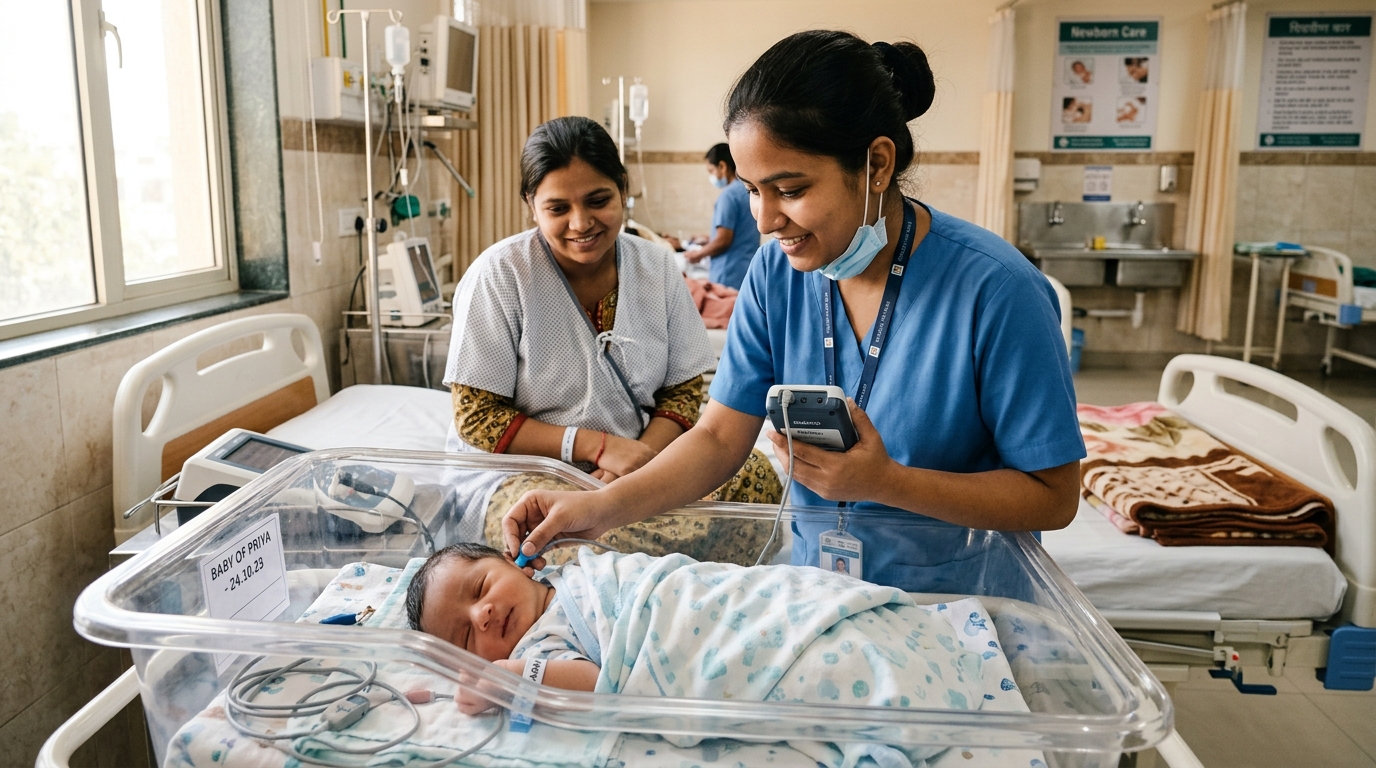
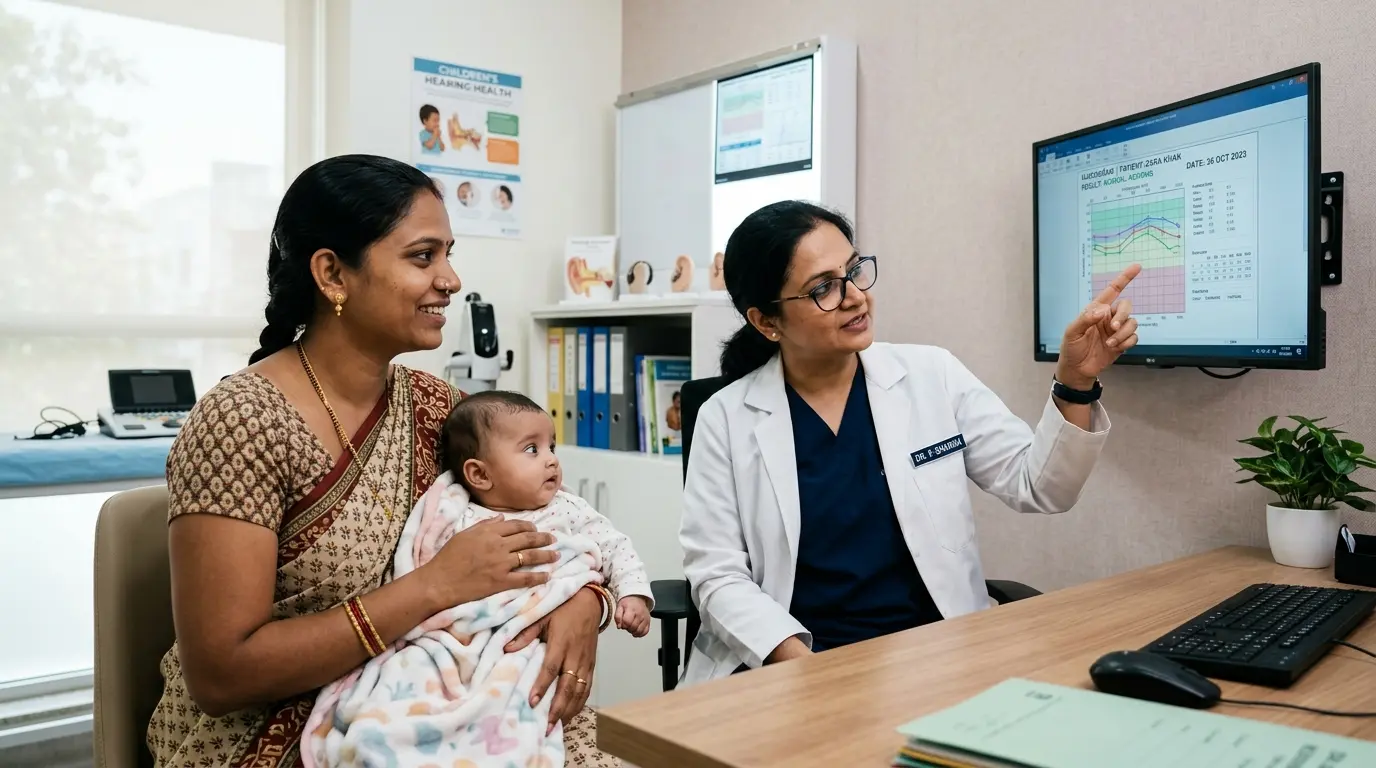
Both screening tests are painless, safe, and quick. There are no needles, no radiation, no discomfort. They are usually performed exactly as in the photo above—soon after birth, in the maternity ward or nursery, while the baby is asleep or quiet, and with the mother seated comfortably beside.
OAE (otoacoustic emissions)
A small soft probe is placed at the entrance of the baby’s ear. It plays gentle sounds and measures a tiny “echo” produced by the healthy outer hair cells of the inner ear (cochlea). If the cochlea is working normally, the OAE response is present.
- Quick (a few minutes per ear).
- Best done on a sleeping or quiet baby.
- Useful as a first-line universal screening tool.
- Limitation: it tests the cochlea but not the hearing nerve or brainstem pathway, so it can miss certain types of hearing loss called auditory neuropathy.
AABR (automated auditory brainstem response)
Soft sticker electrodes are placed on the baby’s head and a tiny earphone delivers clicking sounds. The machine measures how the hearing nerve and brainstem respond to sound.
- Required especially for NICU babies and high-risk babies, where auditory neuropathy is more common.
- More comprehensive than OAE—covers the whole hearing pathway up to the brainstem.
- Slightly longer to perform, but still painless.
In a well-set-up screening protocol, OAE is used for low-risk babies and AABR for NICU/high-risk babies, with referral for full diagnostic testing if any baby fails on repeat screening.
“Refer” does NOT mean deafness
Of all the words in newborn audiology, refer causes the most parental anxiety. It needs to be explained clearly:
- PASS = the screening passed at this attempt; no further screening needed.
- REFER = the screening did not pass; further testing is needed.
A refer result does not automatically mean your baby is deaf. Common, completely benign reasons for a refer include:
- Vernix or fluid in the ear canal (very common in the first 24–48 hours).
- Debris or wax in the canal.
- Baby was crying, moving, or fussy.
- Background noise in the screening environment.
- Equipment fit issues.
Many babies who refer on initial screening are completely normal on repeat testing.
The right response to a refer is not panic, but not delay either. Repeat the screening, and if it still does not pass, proceed promptly to confirmatory diagnostic testing well within the 1-2-3 timeline.
Babies who need extra follow-up even after passing screening
Some types of hearing loss develop after birth or progress over time. The following high-risk features warrant continued hearing surveillance even after a normal newborn screening:
- NICU stay > 5 days.
- Prematurity (especially very low birth weight).
- Severe neonatal jaundice that needed exchange transfusion.
- Family history of childhood hearing loss.
- Congenital infections (CMV, rubella, toxoplasmosis, syphilis, herpes—the TORCH group).
- Bacterial or viral meningitis at any age.
- Craniofacial anomalies (including ear malformations, cleft palate).
- Syndromes known to include hearing loss.
- Ototoxic medications in NICU (such as aminoglycoside antibiotics).
- Persistent middle ear fluid for more than 3 months.
- Developmental delay or parental concern about hearing.
These babies should have repeat audiology assessments in infancy and early childhood, not just one screening at birth.
What parents should watch for at home

Hearing milestones are as important as motor milestones. Watching how a baby reacts to everyday sounds at home—a rattle, a familiar voice, a closing door—is one of the most useful, low-cost forms of hearing surveillance any parent can do. Use the following as a simple checklist; if any markers are missing, ask for an evaluation.
By 3 months
- Startles to loud or sudden sounds.
- Calms when hearing a familiar voice.
- Begins making cooing or vowel-like sounds.
By 6 months
- Turns head or eyes towards interesting sounds.
- Babbles (“ba-ba”, “ga-ga”).
- Reacts to changes in tone of voice.
By 9 months
- Understands simple words (“no”, “bye-bye”, their own name in context).
- Babbles with more variety and intonation.
- Localises sounds from different directions.
By 12 months
- Responds to their name consistently.
- Says one or two recognisable words.
- Follows simple verbal cues with gesture (“come”, “give”).
If a child is consistently missing these markers, do not wait. Request a full pediatric audiology evaluation, even if a previous screening was normal.
Trust parental instinct
One of the most reliable sentences in pediatric ENT is also one of the simplest:
“Doctor, I feel my baby is not hearing properly.”
Parents notice things long before formal tests do. Watching faces intently instead of turning to sounds, sleeping unusually deeply, not reacting to loud doors or vehicles, or being startled only by visual cues—these are exactly the kinds of observations that should trigger a hearing evaluation, regardless of what any earlier screening showed.
At Dr Joel’s Clear ENT Clinic in Thiruvananthapuram, we take parental concern about hearing as a first-line indication for full audiology evaluation. It is far better to do one extra test than to miss one true case.
Treatment today is excellent
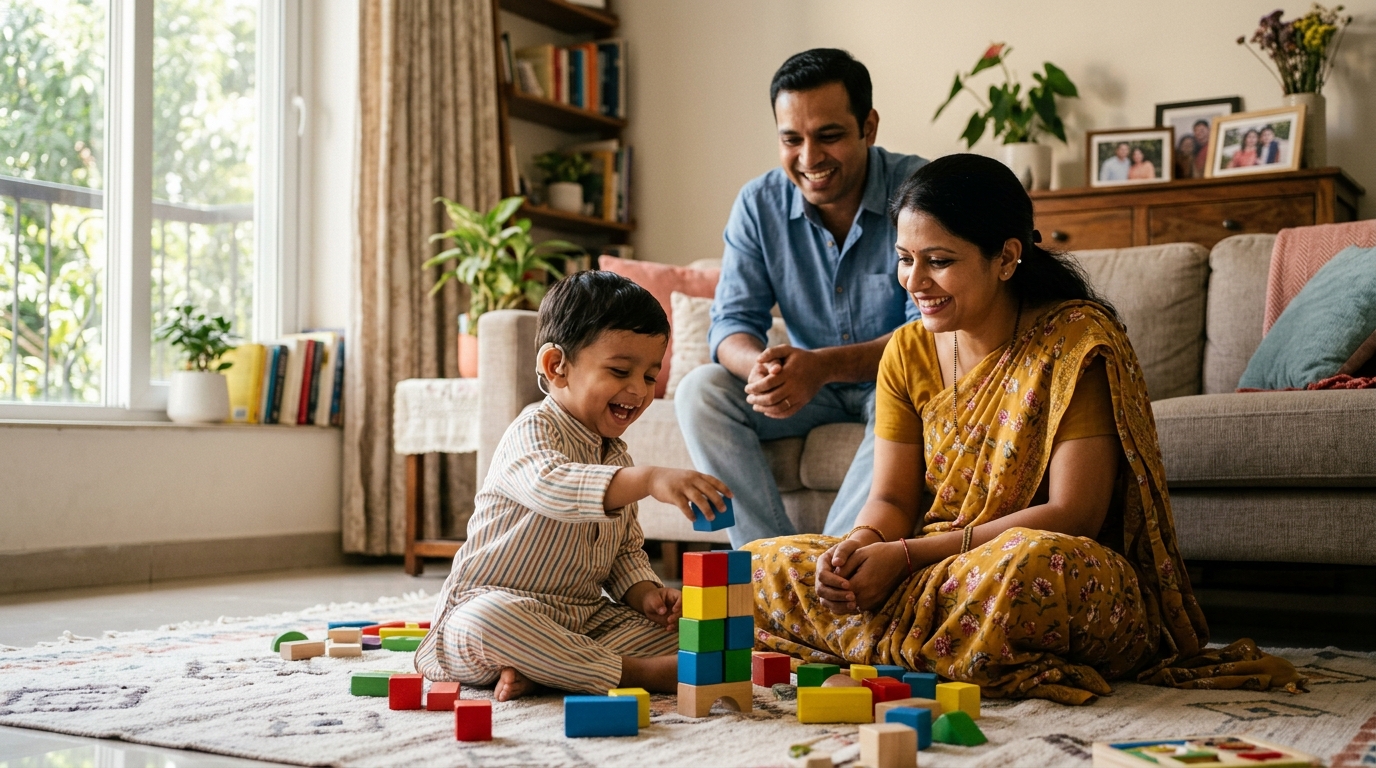
When hearing loss is confirmed, modern paediatric ENT and audiology offer a strong, well-validated set of options. The right combination depends on the type, severity, and cause—and the photo above is exactly the outcome we are working towards: a thriving, age-appropriate child whose hearing aid (or implant) has become an unremarkable part of everyday play.
- Treatment of correctable causes — for example, persistent middle ear fluid (glue ear) is treated medically and, when needed, with grommet (ventilation tube) insertion.
- Hearing aids — even very young babies can be fitted with appropriate amplification, often within weeks of confirmed diagnosis.
- Speech, language, and auditory-verbal therapy — the foundation of habilitation, regardless of the device used.
- Cochlear implant — for severe to profound sensorineural hearing loss not benefiting adequately from hearing aids. Implantation in the first year of life gives outstanding speech and language outcomes when paired with structured therapy.
- Family counselling and support — a structured plan for parents is as much part of treatment as any device.
Children identified and treated early often integrate fully into mainstream schooling and develop language at age-appropriate levels. The earlier the start, the better the trajectory.
A message to grandparents, family, and caregivers
Many of the earliest signs of hearing difficulty are noticed not by the parents but by people who interact with the baby differently—grandparents, aunts and uncles, babysitters, day-care staff, and (later) preschool teachers. If any of the following stand out, please raise it gently and early:
- Baby does not turn to sounds in the room.
- Baby does not react when called by name from behind.
- Baby seems to lip-read or watch faces unusually closely instead of listening.
- Older child speaks late, unclearly, or speaks loudly indoors.
- Older child sets the TV volume very high.
Early conversations save years of late catch-up.
A specific note for Kerala families

Kerala has one of the highest rates of in-hospital deliveries in India. That is a significant opportunity: it means almost every baby in the state can, in principle, be screened before going home. Parents should make sure of the following:
- Ask before discharge whether a newborn hearing screening has been done, what the result was, and whether a follow-up is needed.
- If your baby was in NICU, confirm that AABR—not just OAE—was performed.
- If a refer result was given, arrange repeat or diagnostic testing immediately, not “after a few months”.
- Do not assume “boys speak late” or “he will talk when he’s older”. Sometimes a delayed speaker simply cannot hear well enough to imitate words.
If your baby missed newborn screening, or you have any concern about hearing or speech development, an ENT doctor in Trivandrum with paediatric audiology support can complete the evaluation in a single structured visit.
When to seek pediatric ENT evaluation in Thiruvananthapuram
Book an evaluation at Dr Joel’s Clear ENT Clinic in Thiruvananthapuram if:
- Your baby has not had a newborn hearing screening.
- The screening result was refer and follow-up is pending.
- Your baby has any of the high-risk features listed above (NICU, jaundice, meningitis, family history, infections in pregnancy).
- Your child is missing hearing or language milestones at 3, 6, 9, or 12 months.
- An older child has unclear speech, school difficulties, or seems “selectively” attentive.
- You as a parent have a gut feeling that something is not right with hearing.
A focused pediatric ENT and audiology assessment can rule out hearing loss, identify it early when present, and put a clear plan in place before precious developmental time is lost.
Final word
A baby cannot ask for help. They cannot tell you what they hear or do not hear. Newborn hearing screening gives them that voice.
One small, painless test in the first weeks of life can prevent years of delayed speech, lost learning, and difficult catch-up. And in the small number of babies in whom it picks up real hearing loss, today’s combination of hearing aids, cochlear implants, and structured therapy means outcomes that were unimaginable a generation ago.
If your child missed newborn screening, did not pass screening, or you have any concern about hearing or speech, do not wait. An early consultation with an ENT specialist in Thiruvananthapuram—supported by paediatric audiology—is the single best gift you can give your child’s developing brain.
References and further reading
- Cochlear Implant Group of India (CIGI) — Recent advisory by Dr Manoj M.P., immediate past president of CIGI, on universal newborn hearing screening and the persistent problem of late diagnosis of childhood hearing loss in India. cigi.in
- Indian Academy of Pediatrics — Consensus Statement on Newborn Hearing Screening (Paul A et al., Indian Pediatrics, 2017): screening before 1 month, diagnosis before 3 months, and intervention before 6 months; ABR for all NICU infants.
- Joint Committee on Infant Hearing (JCIH) — Position statements on early hearing detection and intervention (the 1-3-6 / 1-2-3 framework adapted internationally).
- World Health Organization — World Report on Hearing (2021): the case for universal newborn hearing screening as a public health priority.